
The Art of Believing: Inside New York's Furry Puppet Studio
Updated: Sep 26
Tuesday June 30th 2026

Furry Puppet Studio, New York
Tucked away in the creative heart of SoHo, New York, sits a studio that feels almost hidden from time.
There are no rows of computers rendering digital characters, no sterile shelves lined with mass-produced toys. Instead, the space is alive with blocks of foam, vibrant fabrics, hand-sculpted eyes, and an assembly of whimsical creatures that feel as though they might blink or breathe when no one is looking.
Welcome to Furry Puppet Studio, a custom puppet workshop where imagination is shaped, stitched, and brought to life by hand.


Founded by Creative Director Zack Buchman, the studio has quietly established itself as one of the entertainment industry’s more distinctive creative houses, crafting bespoke puppets and creatures for television, advertising, music videos, and live performances.
Their work has appeared in campaigns for brands including Apple, Nike, and Casper, alongside performers ranging from Jon Hamm to Missy Elliott and Michelle Obama.
Yet the story of Furry Puppet Studio is not defined by names or campaigns. It is rooted in something quieter, and more enduring: the preservation of a tactile art form in an increasingly digital world.
Reinventing Puppetry for the Modern Age
A puppet occupies a curious space between object and life. The audience knows it is made of foam and fabric, yet within moments that awareness gives way to something else entirely.
Personality emerges, emotion is believed, and an inanimate object briefly feels alive. It is this transformation that Buchman and his team have spent years refining.
Puppetry is one of humanity’s oldest storytelling traditions, yet for Zack Buchman it is far from a relic.
“There’s an emotional connection that simply doesn’t exist in the same way in other mediums." — Zack Buchman
Their mission is straightforward in principle, if not in execution: to breathe new life into traditional puppetry by merging time-honored craftsmanship with contemporary design sensibilities.
Standing on the Shoulders of Giants

To understand Furry Puppet Studio, you have to look back at the artists who defined puppetry as a modern art form.
Long before digital animation reshaped visual culture, Jim Henson and the Muppets demonstrated that foam, fabric, and wire could carry genuine emotional weight.
Kermit the Frog was never just a character.
Alongside Miss Piggy, Fozzie Bear, Gonzo, and the broader Muppet ensemble, he became part of a shared cultural language—one built on humor, vulnerability, and heart.
That legacy extended into Sesame Street, where Bert and Ernie, Grover, Cookie Monster, and Big Bird became early companions to generations of viewers.
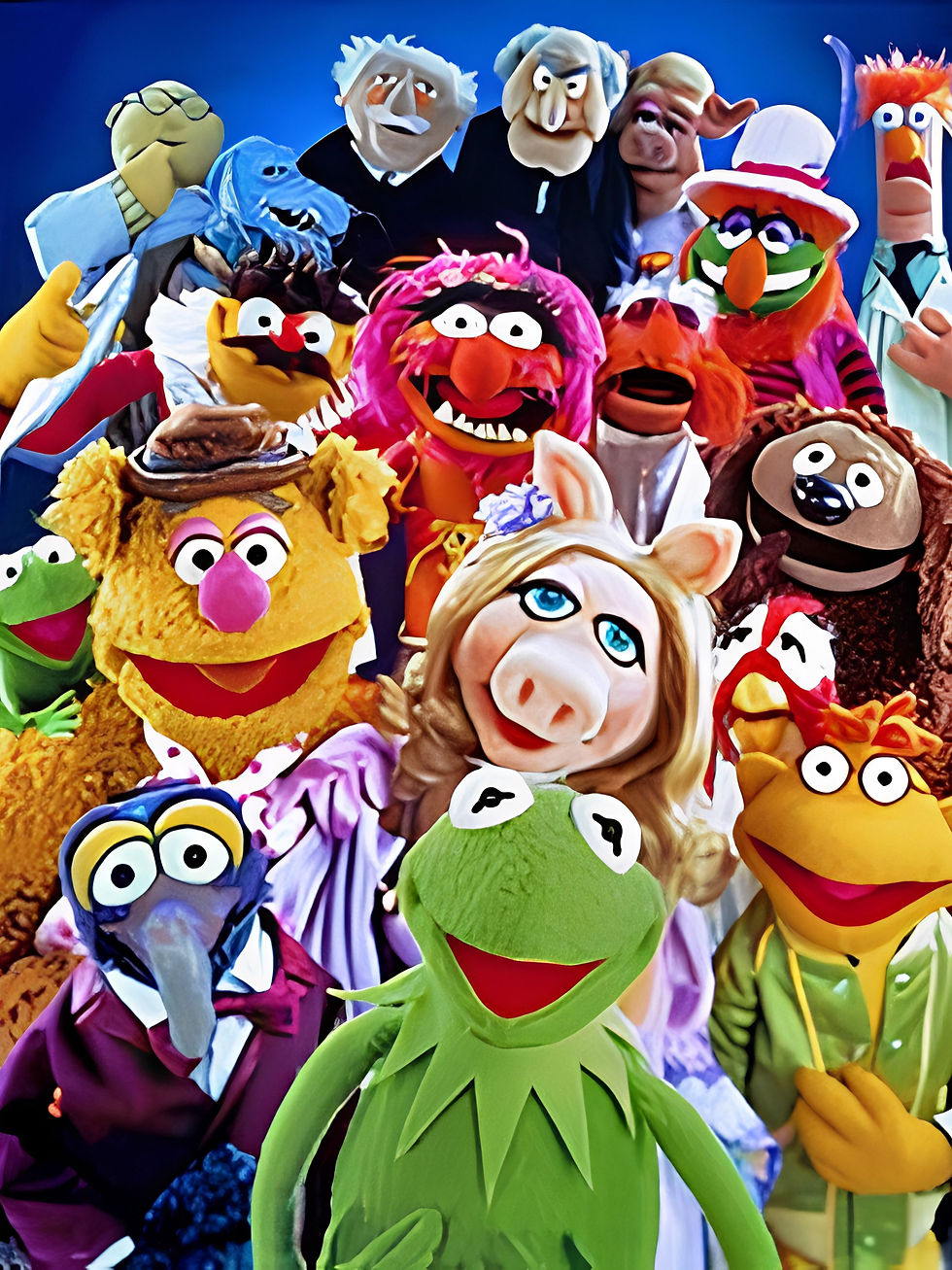
These characters were not simply entertainment. They were presence. It is this same foundational idea that continues to guide Furry Puppet Studio today.
Each puppet is designed with a distinct silhouette and a sense of inner life that extends beyond the hands that animate it.
The goal is not imitation, but continuation of a belief first made visible decades ago:
audiences do not connect with materials—they connect with character.
The tools have changed. The platforms have expanded. The stages are now digital, global, and immediate.
But the intention remains unchanged.
To create something that makes an audience forget, even briefly, that they are looking at foam, fabric, and paint—and instead believe they are encountering something alive.
The Art of Bringing Characters to Life

Every character that leaves the SoHo studio begins in the same place: on paper.
Sometimes it arrives fully formed, a resolved concept that already seems to carry its own presence. Other times it is nothing more than a fleeting sketch—an idea captured mid-motion before it disappears.
From there, the process becomes a precise negotiation between art and engineering.
Blocks of foam are carved by hand until form and expression begin to emerge from the material. Internal mechanisms are developed to bring motion to mouths, eyes, and subtle shifts of expression—the details that suggest thought rather than mechanics.
Fabric is chosen not only for color or texture, but for behavior: how it folds, stretches, and responds when shaped onto the character's form.
Even the placement of the eyes is treated with near reverence. A fraction of an inch can change everything—age, temperament, emotional tone. Nothing remains neutral for long.
In this work, proportion becomes identity.
An Outsider’s Perspective

Buchman’s path into puppetry was not shaped by formal training or a traditional studio pipeline. There was no defined entry point, no institutional framework guiding the work.
Instead, the practice was built independently through animation, character design, and storytelling—developed through observation, repetition, and sustained experimentation.
A language of form and motion was gradually built through doing rather than instruction.
What emerged is a craft shaped by persistence: technique accumulated slowly, and character discovered within the materials rather than imposed upon them—an approach that reflects the impact of an artist working with a genuine voice.
“As an independent illustrator and character designer, I find Zack’s passion and dedication to the creative arts incredibly inspiring.” — Matthew R. Paden
That perspective may be central to the studio’s distinct identity. Unbound by convention, Buchman draws from a wide range of influences—from the pioneering legacy of Jim Henson to early eras of digital character design, where simplicity and silhouette carried emotional weight.
What carries through these influences is a deceptively simple principle: restraint creates presence. A few shapes. A pair of eyes. A subtle shift in proportion. Suddenly, something inanimate begins to feel alive.
A Studio Built on Wonder

In an era increasingly defined by digital imagery and artificial intelligence, there remains something deeply disarming about a hand-built puppet. Every stitch, carved contour, and painted surface carries the unmistakable imprint of human hands.
Every corner of the studio reflects a shared belief: creativity still has the capacity to surprise.
What emerges is more than a prop. It is a performance waiting for its first breath on stage.
Why Puppets Still Matter
The significance of Furry Puppet Studio is not only in what it produces, but in what it preserves.
Technology does not always replace tradition. Sometimes, it redirects attention back toward it.
Puppets endure because they require participation. They do not complete the illusion alone.
They ask the viewer to meet them halfway—to accept the terms of shared imagination.
Whether in advertising, music, or film, the characters emerging from the SoHo studio reaffirm a simple truth: handcrafted storytelling still holds space in contemporary culture, even as the tools around evolve.
What emerges is not survival for its own sake, but evolution—and an ongoing invitation to believe that inanimate materials can become something unmistakably alive.
That is the quiet magic of puppetry.


