
Illustrations vs Cartoons vs Comics - What’s the Difference, and When Do I Use Each One?
- Matthew R. Paden

- Mar 8
- 6 min read

Illustrations vs Cartoons vs Comics
If you spend enough time in the creative world, you’ll notice that the terms illustration, cartoon, and comic often get used interchangeably. Clients use them loosely.
Artists debate them endlessly. And sometimes even professionals blur the lines between them.
I’ve been a professional illustrator and cartoonist for many years, and one of the most common questions I get from clients is something like:
"So… do you do illustrations or cartoons?"
My answer is usually: both—but they serve different purposes.
Understanding the difference between illustrations, cartoons, and comics is important not just for artists, but also for anyone commissioning artwork. Each form has its own strengths, storytelling tools, and ideal uses.
So let me break it down the way I see it from behind my drawing board.
What Is an Illustration?

At its core, illustration is visual communication.
An illustration exists to support, explain, or enhance an idea. It works alongside text, branding, editorial content, advertising, or products to help communicate a message more clearly.
Illustrations appear everywhere once you start paying attention: magazine articles, book covers, product packaging, advertising campaigns, educational materials, and branding.
When I create an illustration for a client, the goal is usually clarity and impact. The image needs to convey a concept quickly. Often the artwork is supporting an existing message rather than being the message itself.
For example, if I’m hired to create an editorial illustration for an article about entrepreneurship, I might design a symbolic image—perhaps a character climbing a mountain made of paperwork or a businessperson navigating a maze.
The image visually reinforces the theme of the article.
Illustration can be:
Conceptual
Realistic
Stylized
Cartoon-like
Painterly
Graphic or minimal
The key point is that illustration is a function, not a style.
A painting can be an illustration. A cartoon drawing can be an illustration. Even a simple icon can be an illustration.
If the image exists primarily to help communicate an idea, then it falls into the world of illustration.
In my own work, most of my commercial projects fall into this category—branding mascots, editorial pieces, product illustrations, and character-driven marketing visuals.
What Is a Cartoon?

A cartoon is a stylistic approach.
Cartoons rely on simplification, exaggeration, and personality. They take real-world subjects and push proportions, shapes, and expressions to create something playful, humorous, or emotionally expressive.
When people say “cartoon,” they usually imagine big eyes, exaggerated faces, and dynamic poses. That’s because cartoons are designed to amplify personality.
In my work as a cartoonist, I love playing with shape language. A character might have oversized hands, a tiny body, or an impossibly expressive face. Those exaggerations make the character feel alive.
Cartoons are commonly used for:
Mascot design
Advertising characters
Humor and satire
Editorial commentary
Children’s media
Animation
Branding
Cartoons have an incredible advantage: they are instantly approachable.
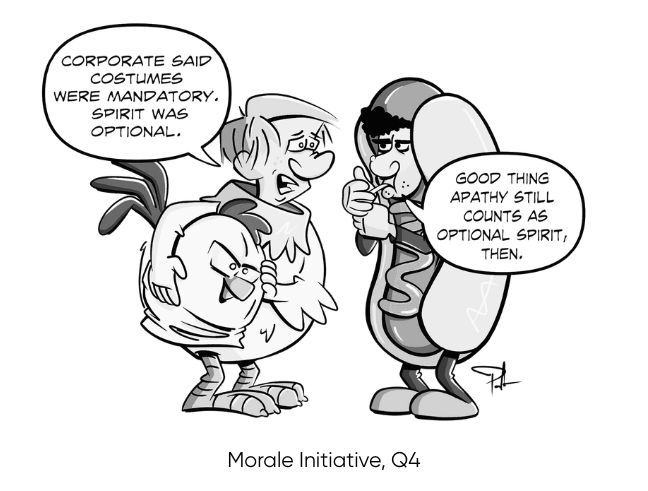
A cartoon character can say things that might feel harsh or uncomfortable coming from a realistic figure. Humor softens the message. That’s why cartoons have such a long history in editorial commentary and advertising.
Cartoons also scale well across media. A good cartoon character can appear on:
Packaging
Websites
Billboards
Merchandise
Social media
Animation
One thing people often misunderstand is that cartoons are not necessarily simple.

They may look simple, but good cartoon design requires a deep understanding of anatomy, gesture, shape balance, and expression.
A well-designed cartoon character can communicate emotion faster than almost any other visual tool.
What Is a Comic?

Comics introduce something that illustrations and cartoons don’t necessarily require:
Sequential storytelling.
A comic tells a story through multiple images arranged in sequence. Each panel builds on the previous one to create motion, pacing, and narrative.
Think of comics as a hybrid between visual art and filmmaking.
Each panel is essentially a shot. The layout becomes editing. The page design controls pacing. Dialogue and captions add voice and character.
Comics can take many forms:
Newspaper strips
Graphic novels
Webcomics
Manga
Editorial strips
Long-form narrative comics
In my own creative projects, comics are where I get to combine everything I love: character design, storytelling, humor, and cinematic staging.
When I work on a comic page, I’m thinking about things like:
Camera angles
Panel pacing
Visual rhythm
Dialogue flow
Character acting
Unlike a single illustration, a comic invites the viewer to experience time.
A character can walk across a room. Pause before speaking. React to a joke. Or reveal something unexpected in the final panel.
Comics are essentially visual storytelling machines.
Where the Lines Start to Blur
Here’s where things get interesting.
In practice, illustrations, cartoons, and comics often overlap.
For example:
A cartoon character used in advertising is technically a cartoon illustration.
A single-panel gag drawing is both a cartoon and a comic. A mascot used in branding might appear in illustrations, cartoons, and comics simultaneously depending on how it's used.
Even editorial illustrations sometimes use cartoon-style characters to communicate serious ideas more effectively. In other words, these categories are not rigid boxes. They’re tools in a creative toolbox.
The real question becomes: Which tool is best for the job?
When I Use Illustration

I turn to illustration when the goal is conceptual clarity.
If the client needs to communicate an idea quickly—especially in marketing, editorial, or branding—illustration is often the right approach.
Illustration works best when:
A concept needs to be explained visually
The artwork supports written content
The message needs to be clear and immediate
The image functions as part of a larger design
For example, if a magazine article discusses the challenges of small business ownership, I might design a symbolic illustration that captures the emotional tone of the piece.
In that case, the image is working alongside the text to strengthen the reader’s understanding of the subject.
When I Use Cartoons
Cartoons are my go-to when personality matters.
If a project needs warmth, humor, or charm, cartoons are incredibly effective. They immediately create a sense of friendliness and approachability.
This is why cartoons are so powerful in branding and marketing. Businesses often want something that feels human and memorable, and cartoon characters accomplish that beautifully.
Cartoons work especially well for:
Mascots
Brand identity characters
Advertising campaigns
Humor-based marketing
Merchandise design
Cartoons also allow for exaggerated body language and facial expressions, which makes them excellent tools for emotional storytelling. A cartoon character can wink, shrug, grin, or panic in ways that feel instantly relatable.
That kind of visual acting is incredibly valuable.
When I Use Comics
Comics come into play when a story needs to unfold. A single image can suggest a story, but a comic lets the audience actually watch that story happen.
This is why comics are ideal for:
Narrative storytelling
Humor strips
Character-driven stories
Educational storytelling
Social media series
webcomics
When I work on a comic, I’m thinking like a director. Where does the camera sit?
What does the character reveal in each panel?
How do I build tension or humor across multiple frames?
Comics allow me to guide the reader’s eye through a sequence, controlling when information is revealed and how the story lands.
It’s an incredibly powerful medium.
Why Understanding the Difference Matters

For artists, understanding these distinctions helps you choose the right creative solution.
For clients, it helps clarify what you’re actually asking an artist to create.
Sometimes a client asks for a “cartoon,” but what they really need is an illustration with a cartoon style.
Other times someone wants a single drawing, but what they really need is a comic strip that explains a process step-by-step.
Knowing the difference allows projects to start on the right creative path from the beginning.
It also helps artists position themselves professionally. Some artists specialize in editorial illustration. Others focus on character design. Some build entire careers around comics and graphic novels.
Each path uses the same foundational skills, but the applications are different.
My Personal Approach
Personally, I love working at the intersection of all three. My illustration work often uses cartoon-style characters because they communicate ideas quickly and memorably.
My comics allow me to explore storytelling and humor. And my character design projects combine illustration and cartooning into something that can live across branding, marketing, and media.
In many ways, these disciplines are not separate worlds—they’re different languages built from the same visual vocabulary. The more fluent you become in each one, the more creative possibilities open up.
Final Thoughts
Illustrations vs Cartoons vs Comics: All share the same DNA: drawing as communication.
But they serve different purposes.
Illustration focuses on explaining ideas. Cartooning focuses on expressive style and personality. Comics focus on sequential storytelling.
Once you understand how they differ—and how they overlap—you can start choosing the right tool for the right creative challenge.
And for artists like me, that’s where the real fun begins. Because sometimes the best solution isn’t choosing one over the other. Sometimes the magic happens when you combine all three.

Comments