
Finding The Heart of Sling Blade Through Karl Childers
by Matthew R. Paden
Tuesday, October 20th 2026

Sling Blade
The first time I watched Karl Childers walk out of the psychiatric hospital, I did not read the scene as a release. I read it as a screenwriting problem.
Here is a man who killed his mother and her lover when he was 12 years old. He has spent most of his life inside an institution.
He speaks in a slow, halting rhythm. He does not process the world the way most people around him do. A less careful film would turn him into a symbol, a threat, a saint, or a puzzle.
The reason Sling Blade still works is that the film does something harder.
It lets Karl become a dramatic center without asking the audience to excuse him, fear him, or reduce him to a diagnosis. That balance is where I found the heart of the film.
For screenwriters and filmmakers, Karl Childers is a case study in how character, place, performance, and moral pressure can carry a story with very little plot machinery. The film does not rush. It observes.
It builds small acts into tragic weight.
Started as a Character Study
The film’s development matters because Karl did not start as a conventional movie protagonist.
Billy Bob Thornton first developed the character through his one-man show Swine Before Pearls. He later adapted that material into the 1994 short film Some Folks Call It a Sling Blade, then expanded it into the 1996 feature.
"I feel more comfortable being Karl than I do myself." - Billy Bob Thornton
That path shows in the final film. The character feels performed from the inside out, not assembled to satisfy a plot outline.
The feature was written, directed by, and starred Thornton. It is set in Arkansas and shaped as an independent Southern Gothic drama.
Its cast includes Dwight Yoakam, J. T. Walsh, John Ritter, Lucas Black, Natalie Canerday, James Hampton, and Robert Duvall. Those are not decorative credits.
Each actor becomes part of the film’s moral design.
Here is the basic fact pattern that frames the case:
Element | What the film does with it |
Release from institution | Starts Karl’s second life without pretending the first one is resolved |
Arkansas setting | Turns place into pressure, not postcard scenery |
Friendship with Frank | Gives Karl a reason to re-enter ordinary life |
Linda’s home | Creates warmth, danger, and ethical tension in the same space |
Doyle’s violence | Forces the story toward a final moral choice |
Sparse dialogue | Makes silence and routine carry emotional meaning |
The film’s major measurable result is also part of the case. It won the Academy Award for Best Adapted Screenplay, and Thornton received an Academy Award nomination for Best Actor.
Those two recognitions line up with what makes the film instructive, the writing and performance cannot be separated.
Core Problem Making Karl Human without Simplifying
The central challenge is plain: how do you build empathy for a character whose backstory includes murder?
"I reckon what you want to know is what I'm doing in here. Well, I reckon the reason I'm in here is because I kill somebody." - Karl Childers
The film does not solve that by making Karl charming.

It does not give him a courtroom speech. It does not flood the audience with flashbacks designed to soften the facts. Instead, it puts Karl in ordinary situations and lets behavior do the work.
He eats. He fixes engines. He listens. He answers questions literally. He tries to understand rules that other characters assume.
He develops a friendship with Frank, played by Lucas Black, and a gentle bond with Frank’s mother, Linda, played by Natalie Canerday.
That approach matters because empathy in drama does not always come from approval. Often, it comes from legibility.
I may not condone Karl’s past, but I can follow how he thinks. I can see what confuses him, what comforts him, what he values, and what he cannot ignore.
The film also avoids another trap. It does not treat Karl’s intellectual disability as a shortcut to purity.
He is capable of tenderness, but he is also capable of violence. He can be innocent in some social ways and dangerous in others. The writing keeps those truths together.
That is where the character gains weight.
Approach Built from Restraint
When I look at the film as a writing case study, the most useful lesson is restraint. The film trusts an audience to sit with discomfort.
Many scenes run on small exchanges. Karl’s speech pattern is slow and repetitive, but the scenes are not empty. They gather information in layers.
When he talks about his past, the film does not score the moment as a shocking reveal. It lets the plainness of his telling make the horror more unsettling.
A typical studio version of this story might heighten every beat:
More flashbacks to the childhood killing
More external conflict after Karl’s release
A clearer villain arc for Doyle
A more explicit psychological explanation
A louder ending
This film chooses a different path. It uses repetition, routine, and place.
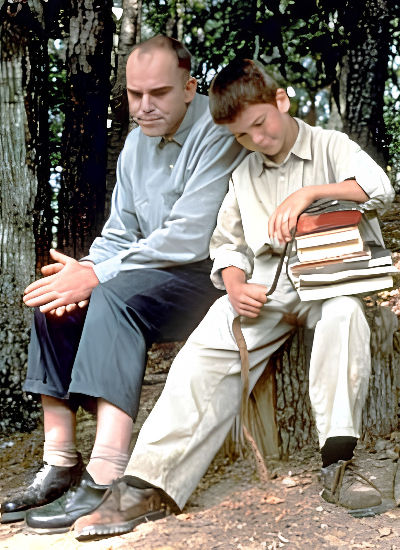
Karl’s work at the repair shop gives him a social function.
The friendship with Frank gives him emotional stakes. Linda’s kindness gives him a glimpse of domestic safety. Doyle, played by Dwight Yoakam, brings threat into that space with drinking, cruelty, jealousy, and control.
None of that is abstract. The film stages danger in rooms, yards, porches, and small-town interiors. It makes the home feel both intimate and unsafe.
That is Southern Gothic at its most practical. The genre elements are not there to announce mood. They expose rot under familiar surfaces.
Supporting Characters by Contrast
Karl is not understood only through what he says. He is understood through how others respond to him.
Frank accepts him faster than most adults would. That choice could have felt sentimental, but the film grounds it in childhood loneliness. Frank needs a stable presence. Karl, in his limited but sincere way, becomes one.
Linda treats Karl with wary kindness. She does not reduce him to his history, but she also does not fully understand what he carries.
Her openness gives the story warmth.
Vaughan, played by John Ritter, adds another layer.
He is gentle, protective, and socially vulnerable in his own way. His presence widens the film’s idea of outsiders. He and Karl both live near the edge of what the town fully accepts, though for different reasons.
Doyle functions as the pressure system. Dwight Yoakam plays him without sanding down the ugliness. Doyle is not complicated in the way Karl is complicated.
He is recognizably abusive. That clarity is important because the film’s final movement depends on a question: what happens when a man with Karl’s past sees a pattern of harm forming again?
J. T. Walsh, James Hampton, and Robert Duvall also help create a world in which people speak plainly, conceal pain poorly, and often accept brokenness as part of daily life. The performances do not feel imported from another movie.
They belong to the same soil.
Backstory into Destiny, not Exposition
Karl’s childhood act is the story’s shadow. The film tells us enough to understand it, but not so much that the past becomes the whole movie.
That is a crucial craft decision.
Backstory often weakens a script when it exists only to explain.
Here, it creates a pattern. Karl once responded to sexual betrayal, family damage, and perceived evil with lethal force. Years later, when he enters Frank and Linda’s life, he sees another household under threat.
The film does not say Karl is right in any simple way. It also does not pretend his final act comes from nowhere. That is the tragic structure. Karl changes in some ways, but the deepest groove in him remains.
The drama works because the ending feels both chosen and inevitable. Those two qualities are hard to hold together. If an ending feels only chosen, it may seem arbitrary. If it feels only inevitable, it may seem mechanical.
Here, Karl’s final decision grows out of everything the film has shown us:
His literal moral reasoning
His attachment to Frank
His memory of childhood violence
His belief that some dangers must be stopped directly
His inability to imagine a socially normal solution
That last point is painful. A different person might call the police, leave town, seek help, or make a plan. Karl returns to the only form of intervention that his history has taught him.
Measurable Result with Lasting Value
The film’s awards history gives one measure of its success. The Academy recognized the screenplay, and it recognized Thornton’s performance. That matters because the film’s impact depends on the unity of writing and acting.
Box-office reporting from sources such as Box Office Mojo has long placed the film’s domestic gross in the tens of millions, a strong result for an independent drama of its kind.
Exact budget figures vary by source, but the commonly reported cost was modest compared with studio dramas of the period.
The practical lesson is clear enough without pretending precision where sources differ: a character-led film, built on performance and voice, reached a wide audience and earned major industry recognition.
For me, the more useful result is not financial. It is structural.
The movie proves that a protagonist does not need a large external goal in order to hold a feature. Karl’s goal is not framed in commercial terms like winning, escaping, solving, or conquering. His journey is quieter.
He is trying to live in the world after being removed from it for most of his life.
That journey creates enough tension because the film plants him in a house where love and danger coexist.
What I Learned from Karl Childers Journey
I found the heart of the film by watching how little it asked Karl to explain himself. The writing gives him room to exist before it asks him to act.
That is a valuable model.
Let Behavior Carry the Moral Argument
Karl’s kindness to Frank matters because the film shows it through time, attention, and presence. He listens. He stays nearby.
He notices danger. The script does not need other characters to announce that he is good or troubled. His actions keep making the case.
Build Place as a Source of Pressure
The Arkansas setting is not just background. It shapes speech, rhythm, religion, labor, class, and silence. The film understands that setting should do more than decorate a frame. It should limit choices and reveal values.
Do Not Confuse Clowness with Emptiness
The pacing gives the audience time to observe. That patience makes the violent ending feel heavier, not weaker. If every scene had been pushed for speed, Karl’s final choice would lose its dreadful calm.
Keep Contradiction Alive
Karl is gentle and violent. Childlike and adult. Honest and frightening. Damaged and capable of care. The film does not resolve those contradictions because the character would shrink if it did.
That is the heart I found: not a clean redemption story, but a tragic study of a man who can love someone and still reach for the only tool his broken moral world has left him.
For filmmakers, that is the enduring lesson.
The strongest characters are not built from traits. They are built from pressures, choices, history, and the silence between what they understand and what they cannot.


